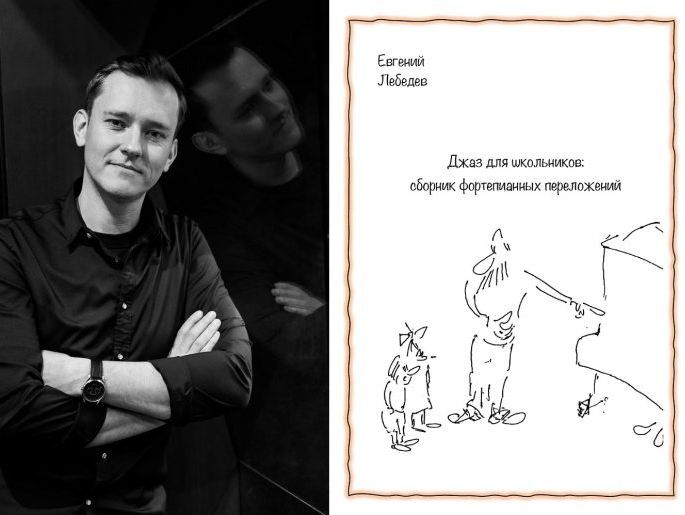
The Igor Butman Foundation has published a sheet music collection, “Jazz for Schoolchildren: A Collection of Piano Arrangements.” The arrangements were created by the world-renowned Russian jazz pianist and teacher at the Moscow State Budgetary Professional Educational Institution “Jazz Academy,” Evgeny Lebedev. Illustrations for the collection were done by another well-known Russian jazz pianist and educator, Evgeny Grechishchev.
FROM THE AUTHOR:
This collection of jazz pieces is designed for use in the jazz piano classroom at children’s music schools. The main goal of this publication is to develop the essential skills that a future jazz pianist needs for successful study at a specialized secondary educational institution in the jazz discipline.
The ten pieces included in the collection represent the golden fund of jazz classics across key styles: swing, bossa nova, jazz waltz, stride piano, and ballad. Four pieces are intended for solo performance, where the student’s main task is to learn to interpret the sheet music independently under the guidance of a teacher. This is especially relevant for free sections (rubato) in ballads and jazz waltzes, where the student decides on preferred dynamics, tempo, and articulations. It is very important for the teacher to provide creative freedom to the student and respect their choices. Young performers must learn to take responsibility for their own interpretations.
In the piece “Unlucky Date,” the student is introduced to basic stride piano skills, with a focus on maintaining rhythmic stability in the left hand, even sound production, and swinging pulse. The remaining pieces are performed with a rhythm section (double bass/bass guitar and drums) or in duet with the teacher. Through these pieces, young pianists learn to read chord symbols and use arranged chords in the accompaniment. At the initial stage, markings can be made directly on the staff. That is why all ensemble pieces are presented in workbook format. Where the left-hand part is written out, the student plays according to the sheet music; in empty areas, under the teacher’s guidance, they add arranged chords and plan their rhythmic structure. For more advanced students, the pieces can be expanded by adding self-composed episodes or incorporating bass and drum solos, after first practicing piano accompaniment with the teacher.
FROM THE PUBLISHER:
The books were presented to a professional audience during the First All-Russian Scientific and Practical Forum on Jazz Education in Moscow on June 14, 2025. Online orders are available with delivery via CDEK and purchase through Ozon (fast shipping). The book will be available in retail bookstores starting September 2025.
FROM THE AUTHOR:
This collection of jazz pieces is designed for use in the jazz piano classroom at children’s music schools. The main goal of this publication is to develop the essential skills that a future jazz pianist needs for successful study at a specialized secondary educational institution in the jazz discipline.
The ten pieces included in the collection represent the golden fund of jazz classics across key styles: swing, bossa nova, jazz waltz, stride piano, and ballad. Four pieces are intended for solo performance, where the student’s main task is to learn to interpret the sheet music independently under the guidance of a teacher. This is especially relevant for free sections (rubato) in ballads and jazz waltzes, where the student decides on preferred dynamics, tempo, and articulations. It is very important for the teacher to provide creative freedom to the student and respect their choices. Young performers must learn to take responsibility for their own interpretations.
In the piece “Unlucky Date,” the student is introduced to basic stride piano skills, with a focus on maintaining rhythmic stability in the left hand, even sound production, and swinging pulse. The remaining pieces are performed with a rhythm section (double bass/bass guitar and drums) or in duet with the teacher. Through these pieces, young pianists learn to read chord symbols and use arranged chords in the accompaniment. At the initial stage, markings can be made directly on the staff. That is why all ensemble pieces are presented in workbook format. Where the left-hand part is written out, the student plays according to the sheet music; in empty areas, under the teacher’s guidance, they add arranged chords and plan their rhythmic structure. For more advanced students, the pieces can be expanded by adding self-composed episodes or incorporating bass and drum solos, after first practicing piano accompaniment with the teacher.
FROM THE PUBLISHER:
The books were presented to a professional audience during the First All-Russian Scientific and Practical Forum on Jazz Education in Moscow on June 14, 2025. Online orders are available with delivery via CDEK and purchase through Ozon (fast shipping). The book will be available in retail bookstores starting September 2025.